Our Lady of Guadalupe is one of the most beloved Marian Apparitions in the Catholic Church and holds a special place in the hearts of millions, especially in Mexico and the Americas. On December 9, 1531, just a decade after the Spanish conquest of Mexico, an indigenous man named Juan Diego was on his way to Mass. As Juan Diego passed Tepeyac Hill, he heard beautiful music and saw a radiant woman who identified herself as the Virgin Mary, the Mother of the True God. She asked him to go to the Bishop of Mexico, Fray Juan de Zumárraga, and request that a church be built on that site so she could spread her love, compassion, help, and protection to all the people. Juan Diego delivered Mary’s message to the Bishop, but he was skeptical and asked for a sign. Discouraged, Juan Diego returned to Tepeyac Hill, where Mary appeared again, reassuring him and asking him to return to the bishop.
On December 12, Mary appeared to Juan Diego yet again. Juan Diego was searching for a priest for his sick uncle, but Mary intercepted him and assured him that his uncle was already healed. She then asked him to climb to the top of Tepeyac Hill, gather flowers found there, and bring them to her. Even though it was winter time, Juan Diego found the hilltop covered in Castilian roses, which were not native to Mexico. Mary arranged the roses in Juan Diego’s cloak and told him to present them to the bishop. When Juan Diego opened his cloak before the bishop, the roses fell to the floor, and the miraculous image of Our Lady of Guadalupe was imprinted on the fabric. The cloak is made of cactus fiber, and it should have deteriorated a few decades after this moment, however, it remains intact to this day nearly 500 years later.
Mary identified herself to Juan Diego as the “perfect and perpetual Virgin Mary, Mother of the True God”. She appeared in mestiza form, speaking in the native Nahuatl language and embracing the culture of the people. Her message was one of love, compassion, help, and protection to all those who sought her. This message was especially tailored towards indigenous people in Mexico who were suffering after the Spanish conquest.
One of the most astonishing outcomes of this apparition was the massive wave of conversions that followed. In the years after her appearance, an estimated 9 million indigenous people converted to Christianity.
The Feast of Our Lady of Guadalupe is celebrated each year on December 12. In 2002, Pope John Paul II elevated the feast to the universal calendar, declaring Our Lady of Guadalupe “Patroness of the Americas”, “Empress of Latin America”, and “Protectress of the Unborn”.
A quote from the apparition: “Am I not here, I who am your mother? Are you not under my shadow and protection?”
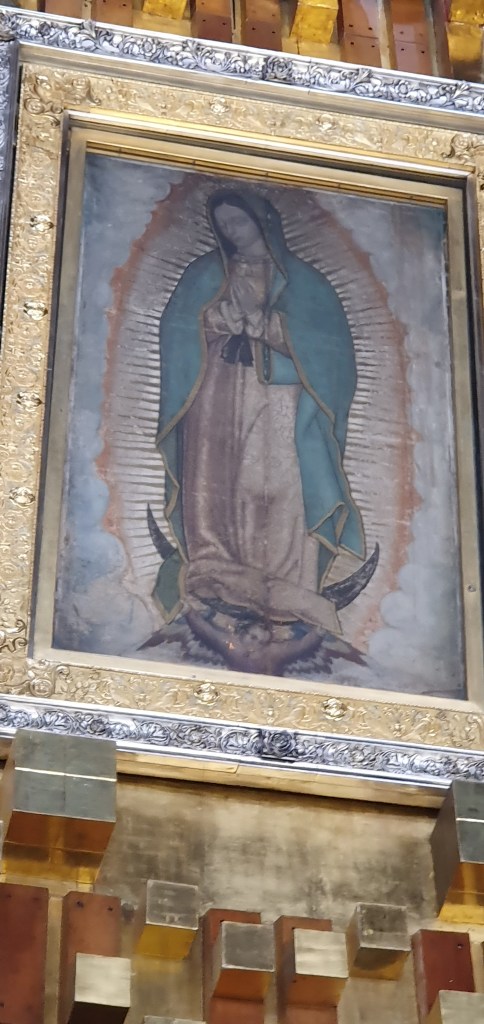
Mary appears as a young, mestiza woman with indigenous features, symbolizing her embrace of the native people of Mexico and their culture. Her mantle is a blue-green color, which is a shade traditionally reserved for royalty and divine beings in Aztec culture. Her tunic is rose-colored, and includes flowers which symbolize life and fertility. Her mantle is also covered with stars, symbolizing her heavenly origin. She is depicted on a crescent moon, which is a symbol connected to Revelation 12:1 : “Woman clothed with the sun”. Around her waist we see a black ribbon, which in Nahuatl culture indicates pregnancy. This reveals she is expecting Jesus. Lastly, an angel supports her, symbolizing her dignity and role as Queen of Heaven.

 Veritas et Lux
