The Rosary is a traditional Catholic prayer that combines vocal prayer with meditation on the mysteries of Christ’s life and the role of the Virgin Mary in salvation history. It is one of the most beloved and powerful devotions in the Catholic Church. It leads us deeper into the life of Christ through the eyes of His Mother. For centuries, countless saints, popes, and faithful Catholics have turned to the Rosary for strength, peace, and grace.
Brief History of the Rosary:
The Rosary’s origins can be traced back to the practice of reciting Psalms in the early Church. Early Christians and monks used knotted ropes or pebbles to count prayers, especially the 150 Psalms. Many lay people were unable to read, so instead they would recite 150 Our Fathers or Hail Marys. This became known as the “Poor Man’s Psalter”. Tradition holds that in 1214 in southern France, St. Dominic received the Rosary in a vision from Our Lady to help combat the Albingensian heresy and sin. She gave it as a spiritual weapon, encouraging the faithful to meditate on the life of Christ while praying Hail Marys. The Rosary, as it is known today, was formalized in the 15th century by the Dominican order.
Purpose of Praying the Rosary:
The Rosary is far more than the repetition of prayers. It is a contemplative journey through the Gospel. In the words of Pope John Paul II, “the Rosary is a compendium of the Gospel”.
- Contemplation of the mysteries of salvation.
- To encourage practical reflection on the life of Christ.
- Mary, our most powerful intercessor, takes our intentions to her Son.
- To form the virtues of humility, charity, purity, patience, and faith.
- The Rosary is a spiritual weapon. Countless saints have testified to its power against temptation and evil.
Structure of the Rosary:
A standard Rosary consists of a crucifix, 5 decades, and a set of opening prayers.
- Holding the Crucifix, do the sign of the cross, then say the Apostles’ Creed
- On the next bead after the Crucifix, say an Our Father
- On the following three beads, say a Hail Mary on each
- On the next bead, say a Glory Be
- Next you start the first of five decades. You announce the mystery, say an Our Father, then on the following ten beads (one decade = ten beads) you say a Hail Mary on each, contemplating the mystery.
- After the tenth Hail Mary, you say a Glory Be and many say a Fatima prayer.
- Move to the next large bead and repeat steps 5-6 for the next decade.
- At the end of the five decades, you will have worked your way around the Rosary back to the starting place of the first decade. End with a Hail Holy Queen, and perhaps an optional prayer like a St. Michael, then do the sign of the cross and you are done.
The Mysteries of the Rosary:
One thing I mentioned above was this word “mystery”. The mysteries of the Rosary are sets of moments that you meditate on while you pray. There are four sets of mysteries: the Joyful Mysteries, Sorrowful Mysteries, Glorious Mysteries, and Luminous Mysteries. I will be making blog posts specific to each set of mysteries with more information, but essentially within each set of mysteries there are five decades (five events) that you contemplate and meditate on while you say your Hail Marys. Let me give you an example of what I mean when I say “meditate on the mysteries”. Let us use the third Joyful Mystery, the Nativity of Jesus, as an example. While you are praying the ten Hail Marys, imagine yourself in the manger as Mary gives birth to Jesus. Picture yourself there with her and Joseph. Put yourself in the scene, and really think about the significance of what is happening. Pretend you are a bystander witnessing the event. What is happening? What are you seeing? That is meditation upon to the mysteries. From the names, you can infer as to what the tone is for each set of mysteries. For example, the Joyful Mysteries are five events from the Gospel that are joyful, the Sorrowful Mysteries contain five events from the Gospel that are sorrowful etc.
Saints/Popes and the Rosary:
Here are a handful of some of the many powerful quotes and testimonies from faithful Catholics over the years regarding the Rosary:
“Say the Rosary every day. Pray it with devotion. There is no problem, no matter how difficult… that cannot be solved by the power of the Rosary”. – Sister Lucia of Fatima
“The Rosary is a powerful weapon to put the demons to flight and to keep oneself from sin”. – St. Louis de Montfort
“The Rosary is a weapon for these times”. – St. Padre Pio
“The Rosary is the most beautiful and the most rich in graces of all prayers; it is the prayer that touches most the Heart of the Mother of God… and if you wish peace to reign in your homes, recite the family Rosary”. – Pope Pius XII
“The Rosary is a powerful weapon to put demons to flight and to keep oneself from sin… If you desire peace in your hearts, in your homes, and in your country, assemble each evening to recite the Rosary. Let not even one day pass without saying it, no matter how burdened you may be with many care and labors”. – Pope Pius XI
Final Reflection:
As you can see, the Rosary has proven to be a powerful devotion in the Church. Of course, by no means is it required for Catholics to pray, however it is a great prayer to recite and it is highly encouraged. Personally, I am pleased to say that starting on January 1 of this year, I have prayed the Rosary without missing a day. It has turned into something I look forward to each day, and I can feel and see the graces flowing from it. It is important to realize though that each time you pray it, there is not going to be some complex, life-changing revelation. Prayer life is far from that. Despite countless amazing testimonies from saints throughout the ages, the day to day prayer life can feel mundane sometimes. That is ok! It is part of the process. The Christian way of life is a grind. We have to put the work in each day, and it often takes a while to see the fruits of your work. The important part is staying consistent and trusting in God. When I first started praying the Rosary last year after coming back to the faith, it felt like a job at times. I got bored quickly sitting there for twenty minutes alone reciting the prayers. My mind would often wander to other things. That may happen to you as well if you decide to begin to start praying, and that is ok. A practical suggestion I have is to start bit by bit. For example, a priest I know prays his Rosary daily, but he spreads the decades out throughout the day. One decade in the morning, one at lunch, etc. Get creative! Perhaps it would be more beneficial for you to just pray one decade a day until you get the swing of things. Figure out what works best for you, stick with it, and stay consistent. Also, you do not have to sit alone in a dark and quiet room to pray it. For some that may be ideal, however if you have trouble sitting in silence like that, I recommend praying it while on a walk, while driving, in adoration, or in line for confession. Remember, God will be happy to see the effort you are putting in! I truly recommend a daily Rosary as I have seen the benefits of adding it to my daily routine, however that can be daunting at first when you are starting out. Thus, try and come up with a game plan, pray to the Lord for strength to stay consistent, and over time you can add more and more to your routine. The Rosary is a gift. It is a spiritual lifeline offered by the Blessed Mother to draw us into the heart of her Son. In a world of noise and anxiety, it is a prayer of peace, clarity, and grace.
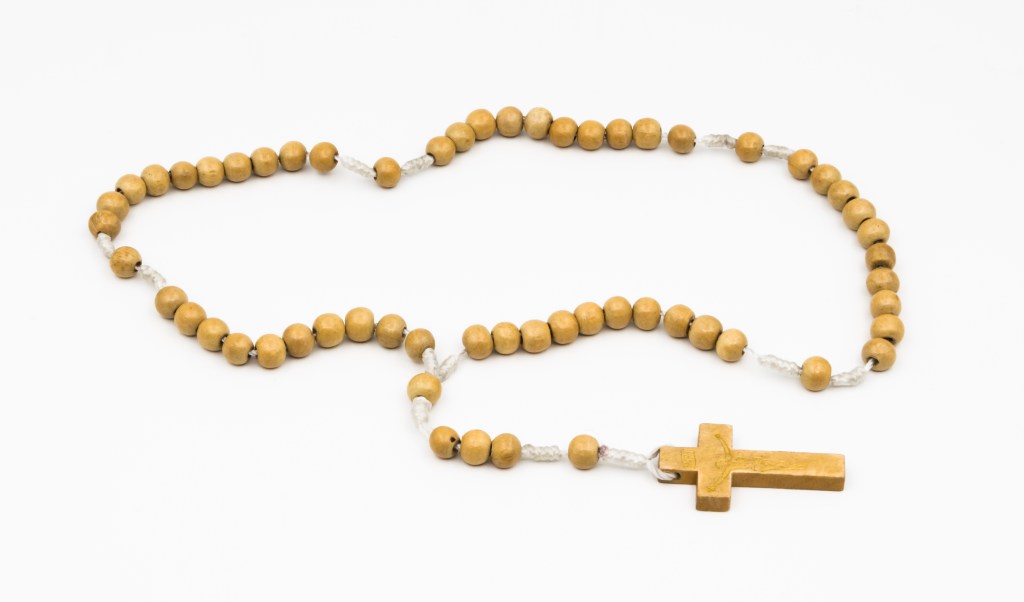
Note: Notice the structure of the Rosary. You have your cross (crucifix on most Rosaries) where you say the Apostle’s Creed, then you have a standalone bead where you say the Our Father, then three beads together for three Hail Marys, then another standalone bead where you say the Glory Be and start the first decade. Notice the five sections of ten beads. These are the decades. Ten Hail Marys. Each standalone bead around the Rosary is the beginning of a new decade.

A painting of St. Dominic by Renaissance painter Titian
 Veritas et Lux
Leave a comment